
Testing · 4 min read
What lab tests can and cannot prove: HPLC, mass spectrometry and certificates
Identity, assay and purity are different questions. What HPLC and mass spectrometry each measure, and why “lab tested” can mean almost nothing.
- Published
- Sources
- 8 cited
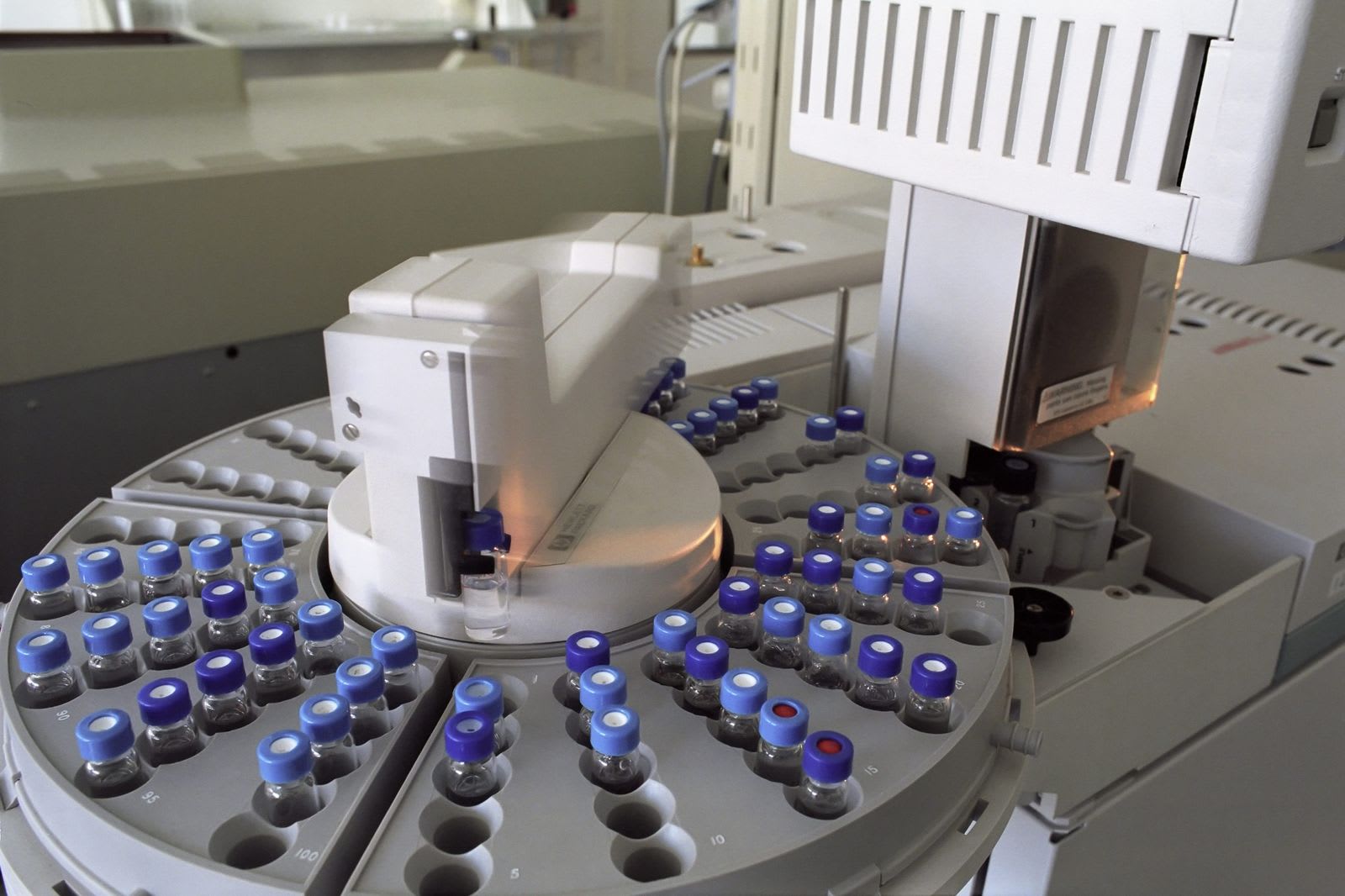
"Lab tested" is printed on a great many products, and it can mean almost anything. One test can prove a substance is present. Another can measure how much. A third can do neither while still producing a number that looks authoritative on a certificate. This guide explains what the two workhorse techniques, HPLC and mass spectrometry, actually measure, what each can and cannot establish, and why the difference decides whether a certificate is worth reading.
Three different questions
A laboratory examining a product is usually answering some combination of three questions, and they are not interchangeable.
- Identity. Is the substance what the label says?
- Assay. How much of it is there, compared with what the label claims?
- Purity. What else is present, and how much of it?
A product can pass one and fail another. In a 2022 meta-analysis of 5,413 anabolic steroid samples, 44% of the counterfeits contained a different substance, a failure of identity, while among the substandard products two thirds were simply under strength, a failure of assay.[8] A test that answers only one of these questions leaves the others open.
1Identity
Is it what the label says?
Usually by
Mass spectrometry, usually paired with liquid or gas chromatography (LC-MS, GC-MS).
Look twice at
Identity claimed from an HPLC retention time alone. That is not specific.
2Assay
How much of it is there?
Usually by
HPLC, measured against a calibration curve built from a reference standard.
Look twice at
A figure with no label claim and no acceptable range beside it.
3Purity
What else is in it?
Usually by
HPLC impurity profile, with mass spectrometry to identify unexpected peaks.
Look twice at
“Not detected”, which means below that method’s detection limit, not absent.
HPLC: separating a mixture and measuring it
High-performance liquid chromatography (HPLC) pushes a dissolved sample through a packed column. Different compounds travel through the column at different speeds, so they come out one after another. A detector, often measuring ultraviolet light, records each one as a peak.
The output is a chromatogram, a line with peaks. The height and area of each peak correspond to the concentration of the compound, and the time at which it emerges, its retention time, is characteristic of the compound under those conditions.[1]
What HPLC is good at
HPLC is excellent at how much. Most quantitative HPLC methods compare the sample against external standards, measuring known amounts of a reference substance to build a calibration curve, and read the sample's concentration off that curve.[2] It is also good at what else: impurities show up as extra peaks, and their areas can be measured.
What HPLC cannot do on its own
HPLC alone is weak at what it is. A peak appearing at the expected retention time is consistent with the right compound, but a different compound can emerge at the same moment. The international guideline on specifications for medicines, ICH Q6A, is direct about this: identification "solely by a single chromatographic retention time, for example, is not regarded as being specific".[4]
Mass spectrometry: identifying what a compound is
A mass spectrometer turns molecules into charged ions and sorts them by their mass-to-charge ratio (m/z). Many molecules break into characteristic fragments, and the pattern of ions and their proportions is reproducible, which is what allows a compound to be identified.[3]
Mass spectrometry is commonly coupled to a chromatograph (LC-MS or GC-MS), so that each separated compound is identified as it emerges.[3] That pairing is what closes the gap HPLC leaves. ICH Q6A names combinations such as HPLC/MS and GC/MS as generally acceptable for identification.[4]
What makes a test trustworthy: validation
A method is not reliable because it uses expensive equipment. It is reliable because it has been shown to work for that particular measurement. The ICH guideline on validating analytical procedures, Q2(R2), sets out what that demonstration involves.[5] Among its characteristics:
- Specificity: "the extent to which other substances interfere with the determination of an analyte". At its fullest, it means measuring the substance unequivocally.[5]
- Accuracy: how close the measured value comes to the accepted true or reference value.[5]
- Precision: how closely repeated measurements agree, within one run, between days and between laboratories.[5]
- Range, including the detection limit: the lowest amount that can be detected, though not necessarily measured exactly.[5]
That last point matters when a certificate says a contaminant was "not detected". It means not detected by that method, above its detection limit. It does not mean absent.
What a laboratory's accreditation covers
ISO/IEC 17025 is the standard for the competence of testing laboratories, and accreditation against it is granted for a scope of accreditation, which A2LA describes as "a list of all the tests or inspections" the laboratory has been assessed for.[6] A laboratory accredited for one test is not accredited for every test it offers. When you read a certificate, check the scope for the specific test named on it. How to read a certificate of analysis shows how.
The limit every result shares
Every result applies to the sample that was tested and nothing else. ISO/IEC 17025 requires test reports to say so: results relate only to the items tested.[7] A good certificate for one vial is evidence about that vial. It is only evidence about the vial in your hand if the two can be shown to come from the same batch, which is why batch numbers matter as much as the chemistry.
Questions to ask about any "lab tested" claim
- Which laboratory, and can it be contacted directly?
- Which tests: identity, assay, purity, or only one of them?
- Which method for each, and can that method establish what it claims? Identity by retention time alone cannot.
- Is the laboratory accredited, and is this test on its scope?
- Does the batch tested match the batch you have?
If a seller cannot answer these, "lab tested" is a marketing phrase, not a finding. For the packaging and seller checks that come first, see how to spot counterfeit steroids and falsified medicines.
Questions
- Can HPLC prove what a substance is?
- Not on its own. HPLC is strong at measuring how much of a compound is present, but ICH Q6A states that identification by a single chromatographic retention time is not regarded as specific. Pairing chromatography with mass spectrometry is generally acceptable.
- What is the difference between HPLC and mass spectrometry?
- HPLC separates the compounds in a sample and measures each one, which makes it good for quantity and impurities. Mass spectrometry sorts ions by mass-to-charge ratio, producing a reproducible pattern that identifies a compound.
- What does “not detected” mean on a lab report?
- That the substance was not found above that method’s detection limit. It does not mean the substance is absent.
Sources
- 1.Chromatography (StatPearls) — NCBI Bookshelf, 2024
- 2.High-performance liquid chromatography (Analytical Chemistry 2.1, §12.5) — LibreTexts (Harvey D)
- 3.Mass spectrometer (StatPearls) — NCBI Bookshelf, 2024
- 4.ICH Q6A: Specifications, test procedures and acceptance criteria for new drug substances and new drug products (CPMP/ICH/367/96) — European Medicines Agency, 2000
- 5.ICH Q2(R2): Validation of analytical procedures — International Council for Harmonisation, 2023
- 6.Frequently asked questions: ISO/IEC 17025 and scope of accreditation — A2LA
- 7.Common calibration certificate findings (ISO/IEC 17025 clause 7.8.2.1) — A2LA
- 8.Fake anabolic androgenic steroids on the black market: a systematic review and meta-analysis on qualitative and quantitative analytical results found within the literature — BMC Public Health (Magnolini R et al.), 2022
General information for educational purposes. It is not medical or legal advice, and laws and evidence change. Where it matters, check the primary sources above and speak to a qualified professional where you live.